Portable power stations: how to size one and what the specs mean
Watt-hours vs watts, usable capacity, LiFePO4 vs NMC, solar input, UPS mode, flying with batteries and why a power station is not a generator.
Updated 2026-11-27
A portable power station is a big rechargeable battery with an inverter, sockets and a charge controller in one box. Buying the right one comes down to two numbers, energy and power, then a handful of features that decide how you can recharge it and how long it lasts.
Watt-hours, watts and surge: three different numbers
- Capacity (Wh) is how much energy the battery holds. It decides how long things run.
- Output (W) is how much power the inverter can deliver at once. It decides what you can plug in. A kettle that draws more than the rated output simply won't run, however big the battery.
- Surge or peak (W) is a short burst above the rated output. BLUETTI explains that motors and compressors in fridges, pumps and air conditioners need a brief spike of extra power to start, and if the station can't supply it the appliance won't start or the station overloads (BLUETTI: running vs starting watts). Check your appliance label or manual for its starting figure.
Read marketing terms carefully. BLUETTI's Elite 200 V2, for example, is rated at 2,600W continuous with a 3,900W "Power Lifting" mode that BLUETTI describes as being for pure resistive loads such as kettles and hair dryers (BLUETTI Elite 200 V2 page). That mode helps with heating appliances; it is not the same thing as a motor-starting surge rating.
Usable capacity is less than the number on the box
You never get the full rated watt-hours out of the AC sockets. BLUETTI's own runtime guide lists three losses: the battery isn't drained to zero (it gives 80–95% as typical for LiFePO4), converting DC to AC costs energy (it puts good inverters at 85–95% efficient), and the unit uses some power just being on, for its screen, fans and battery management (BLUETTI runtime guide). The same guide gives roughly 15W idle draw for its Elite 300 as an example.
A practical estimate:
- List what you'll run and each item's watts. Multiply by the hours you need it: that's watt-hours.
- Add the totals, then add the station's idle draw multiplied by the hours it will be on.
- Divide by about 0.8 (a rough allowance for the losses above). That is the rated capacity to look for.
Example: a 60W router and modem for 10 hours is 600Wh, plus 15W idle for 10 hours is 150Wh, so 750Wh needed and roughly 940Wh rated capacity to be safe. Phones and laptops charged over USB-C skip the inverter, so they usually stretch further than this sum suggests.
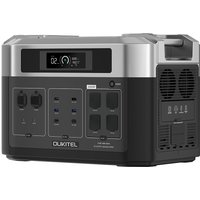
 BLUETTI Elite 200 V2 Portable Power Station | 2,600W 2,080Wh | 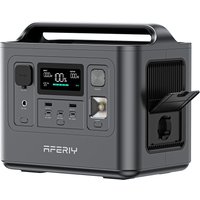 AFERIY P010 Portable Power Station 800W 512Wh |  AFERIY P040 Portable Power Station 400W 256Wh | |
|---|---|---|---|
| Price | $899 | $299–$327.29 | $199–$235.28 |
| Store | BLUETTI US | Geekbuying | Geekbuying |
| Capacity | 2,080Wh | 512Wh | 256Wh |
| AC output | 2,600W | 800W | 400W |
| Battery | LiFePO4, 6,000+ cycles to 80% (BLUETTI) | See listing | See listing |
| Can fly on a passenger plane | No (over 160Wh) | No (over 160Wh) | No (over 160Wh) |
| See it | See it | See it |
LiFePO4 vs NMC: why chemistry matters
Most power stations now use lithium iron phosphate (LFP or LiFePO4) cells. BLUETTI's chemistry guide gives LFP a typical life of 2,500 to 6,000+ cycles to 80% capacity against 1,000 to 2,000 for NMC, and says LFP is more thermally stable but heavier for the same energy (BLUETTI: types of lithium batteries). Those are chemistry-level ranges, not guarantees for any one product, so look for the maker's own cycle rating. The Elite 200 V2's spec sheet, for instance, lists LiFePO4 with 6,000+ cycles to 80% of original capacity and a five-year warranty (BLUETTI Elite 200 V2 specs).
If you only use a station a few weekends a year, cycle life barely matters and a lighter NMC unit can make sense. If it will sit on daily solar duty or act as a backup that cycles often, LFP is the better long-term buy.
Solar input and panel sizing
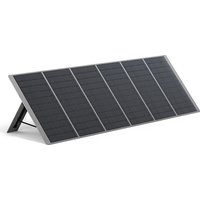
Every station has a solar input limit in watts and a voltage window. The Elite 200 V2 accepts up to 1,000W at 12–60V and 20A (BLUETTI Elite 200 V2 specs). Panels wired above the voltage limit can damage the input; panels above the wattage limit just get capped.
A panel's rating is measured at 1,000 W/m² of sunlight, so real output is lower for most of the day. BLUETTI's sun-hours guide explains "peak sun hours" as the equivalent number of hours at that full intensity, says many regions get only 4–6 per day, and suggests NREL's PVWatts calculator to look up your own location (BLUETTI: peak sun hours).
Rough sizing: daily watt-hours you want back ÷ your peak sun hours = panel watts, then add some margin for heat, dust and angle. Refilling 1,000Wh in a place with 5 peak sun hours needs at least 200W of panels, and more in winter.



Pass-through charging and UPS mode
Pass-through means the station can charge and power devices at the same time. A UPS (uninterruptible power supply) mode goes further: devices run from the wall and the station takes over when the power cuts. Switchover time matters for computers and network gear. BLUETTI quotes 15ms or less for the Elite 200 V2 and lists four UPS modes, including one that holds the battery at 100% for backup and one that prioritises solar (BLUETTI Elite 200 V2 FAQ). If you want it for medical equipment, ask the maker whether that use is supported before relying on it.
App control
Apps show live input and output, let you change charging speed and UPS settings and send outage alerts. Check whether the app connects over Bluetooth only (works in the room) or Wi-Fi too (works remotely). The Elite 200 V2 supports both (BLUETTI Elite 200 V2 specs). The station should still work from its own buttons if the app or account ever goes away, which you can confirm in the manual.
Flying with a power station: almost always no
The FAA limits passengers to lithium-ion batteries of 100Wh each without approval; 101–160Wh needs airline approval (two spares at most), and anything over 160Wh is forbidden. Spare batteries and power banks must go in carry-on, never checked bags (FAA PackSafe: lithium batteries). The FAA's passenger table specifically lists stand-alone and backup generators and solar power system batteries as over the 160Wh limit and forbidden in both cabin and hold (FAA: airline passengers and batteries). To check a battery, multiply its voltage by its amp-hours to get watt-hours (FAA). Airlines can be stricter still.
Power station vs gas generator: the safety difference
A battery power station burns no fuel and has no engine exhaust. A fuel generator is a different machine. CPSC warns that generator exhaust contains carbon monoxide, which you can't see or smell, that more than 80 people die each year from CO poisoning linked to portable generators, and that a generator must never run inside a home or garage even with doors and windows open. It says to run one outside only, at least 20 feet from the house with the exhaust pointed away, and to fit battery-powered or battery-backup CO alarms (CPSC: generators and carbon monoxide). CPSC adds that dangerous CO can linger for hours after the generator shuts off (CPSC safety alert).
The trade-off: a generator keeps going as long as you add fuel, while a power station is limited by its battery and how fast you can recharge it. For a few hours to a day of essentials, or for apartments where a generator isn't an option, a power station is the simpler choice.
Quick checklist
- Output (W) above your biggest single appliance, with surge headroom for anything with a motor.
- Capacity (Wh) from your own load list, divided by about 0.8.
- LFP chemistry and a stated cycle rating if you'll use it often.
- Solar input watts and voltage window that match the panels you plan to buy.
- UPS switchover time if it will protect a computer or router.
- Warranty length and where support is based.
Budget
 AFERIY Nano100 Portable Power Station 100W 992Wh$99–$112.70 · GeekbuyingAFERIY P040 Portable Power Station 400W 256Wh$199–$235.28 · Geekbuying
 BLUETTI Elite 10 Mini Power Station | 200W 128Wh - Gray$129.99 · BLUETTI US
Price bands split the 95 matching in-stock listings into thirds by price; they move as the catalog updates.
Related: What not to put on a smart plug · The hidden running costs of smart devices · All power stations and solar panels